Ant control in York Region comes down to ant nest removal: store spray never ends an ant problem because it drops the foragers on your counter and never touches the queen or the nest she runs. Across York Region suburbs the usual indoor offenders are pavement ants, odorous house ants, and pharaoh ants, and each one is beaten from the nest outward with bait the workers haul home, not with a poison line at the threshold. In Vaughan, see ant extermination in Vaughan. A typical ant visit here lands between $150 and $300, one treatment plus a check-back, backed by our two-month guarantee. The season opens in April and holds through September, and a single trail crossing the kitchen in May is the cheap version of this call.
Why you have ants, and why it is almost always spring to summer
Two things pull ants indoors: something to eat and something to drink. In York Region the clock starts in April as the soil warms and the outdoor colony stirs, and it runs hard until September. One scout finds the crumbs behind the toaster or the damp under the sink, marks a scent line back to the nest, and the rest of the colony walks the same line in. The "sudden invasion" on your patio door is really one outdoor nest that has decided your kitchen is the nearest open store.
Which species you have sets the plan. Pavement ants nest beneath driveways, interlock walkways, and slab foundations, then surface through the cracks, a common sight on the newer subdivision lots across Markham and Vaughan. Odorous house ants smell like rotten coconut when crushed and chase moisture, so they turn up at dishwashers and under leaking sinks in larger detached homes. Pharaoh ants are the difficult ones: tiny, pale yellow, nesting deep in warm wall voids, and most often found in the older condo and apartment stock around Thornhill and Markham.
Spraying pharaoh ants makes them worse, because the colony splits and scatters new nests through the building, a process called budding. That one fact is why a hardware-store can backfires worst on the exact ant that most needs a technician.
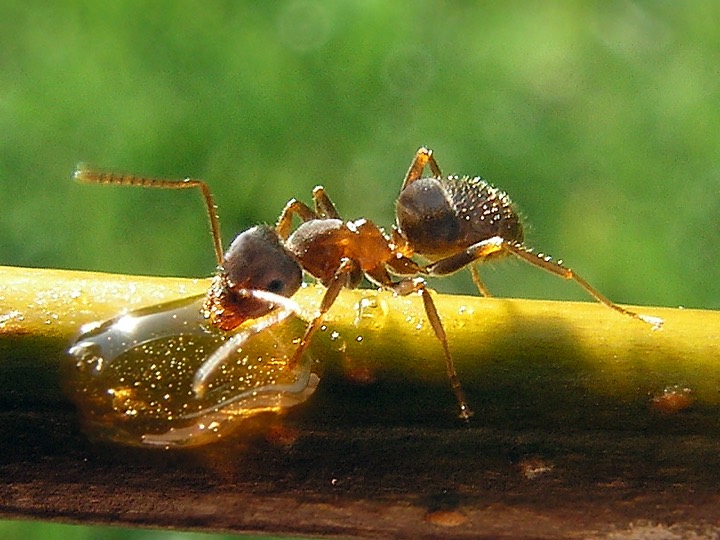

The signs it is ants, and which kind
- A steady trail of ants along a baseboard, counter edge, or windowsill, running to and from one point. A trail means a nest, not a stray.
- Ants around water: under the kitchen sink, behind the dishwasher, near a bathroom pipe. Odorous house ants in particular follow moisture.
- A faint rotten smell when you crush one. That is the odorous house ant, named for exactly that.
- Tiny pale-yellow ants in a hospital-like spread through a condo or apartment, in bathrooms and kitchens at once. That points to pharaoh ants, and it needs baiting, never spray.
- Small piles of soil pushed up between paving stones or along the foundation, the sign of a pavement ant nest below.
If the ants are large and black and you are finding coarse sawdust, that is a different problem. Read the carpenter ant control page, because those nest in your wood and the treatment is not the same. On the treed estate lots common in York Region, carpenter ants are the more likely culprit.
Why the store spray fails, and what actually works
A store aerosol drops the foragers it touches and lays down a repellent band the survivors simply detour around. The colony keeps hatching hundreds more workers, the queen never encounters the product, and the trail you wiped out on Saturday is back by the following weekend.
Baiting flips the logic. Workers carry a slow-acting bait home and feed the queen and brood before it takes hold, so the collapse works from the centre out. Looking slow for the first few days is the whole point. Here is the sequence we run:
- Inspection (free). We trace the trails to the entry point and, where it is reachable, the nest itself, then identify the species, since pavement ants and pharaoh ants are not baited alike.
- Targeted baiting. We set bait the workers will actually take, matched to whether the colony is chasing sugar or protein at that point in the year. Health Canada's Pest Management Regulatory Agency registers these products and weighs their risk to children and pets before approval, and we apply them to the label.
- Perimeter and entry treatment where it fits. For pavement ants marching in from outside, we treat the exterior nest and the entry points so the source is cut, not just the trail on the tile.
- Follow-up. We come back to confirm the trails are gone and the colony has collapsed, and re-bait if a satellite nest is still working.
Do not spray a pharaoh ant trail. It triggers budding, the colony splits, and a one-room problem becomes a whole-building one. If the ants are tiny and pale and spread through more than one room, stop spraying and call.
What ant control costs in York Region
A standard York Region ant treatment runs $150 to $300. Where you land depends on the species, how many nests are active, and whether the source is one outdoor colony or several tucked inside a wall. A lone pavement-ant trail from the driveway sits at the bottom. A pharaoh ant spread through an older Thornhill condo, needing repeat baiting, sits at the top.
| Job | Typical York Region range |
|---|---|
| Single trail, one nest, general ants | $150 to $250 |
| Whole-home general ant treatment | $200 to $300 |
| Pharaoh ants / multi-nest baiting program | $300 to $450+ |
| Follow-up visit (included in most jobs) | usually no extra charge |
Carpenter ants are their own job and cost more, because finding the nest inside the structure is the real work. Those run $250 to $500 and are covered on the carpenter ant page. Every pest and its price is on the full cost page.
Do you need a pro, or can you do it yourself?
One short pavement-ant trail off a patio, caught early, is often a job you can handle: wipe the line to break the scent, clear the crumbs, and set a sugar-based bait station where they appeared. Give it a week. Bring in a pro when the trails keep returning, when they run through more than one room, when they are the tiny pale pharaoh ants, or when spray has already been tried and failed. Each of those means a colony that is dug in and will not be out-baited from a shelf product. Our honest do-I-need-an-exterminator guide walks the line.
Keeping ants out through the season
Ant prevention across York Region comes down to moisture and food. Fix the drip under the sink and the leaking hose bib, because odorous house ants track water into the house. Wipe counters down and keep sugar, honey, and pet food in sealed containers. Caulk the obvious cracks along the foundation and around door frames. Keep mulch and firewood off the foundation, since the mature landscaping on older York lots is exactly where pavement and other outdoor ants nest before they find a way in. None of this clears a colony already inside, but it decides whether a new one moves in after we treat.
By town: ants in Markham, Richmond Hill, Vaughan, Newmarket and Aurora
Small ants and carpenter ants are different jobs, and which one you have depends a lot on how old and how treed your street is.
- Markham: pavement ants along driveways and slab edges in the subdivisions; big black ants indoors in Unionville or Thornhill are usually carpenter ants, which is a nest-in-wood job.
- Richmond Hill: pavement and odorous house ants in Jefferson, Richvale and Crosby, and the occasional pharaoh ant colony in a Yonge Street condo kitchen, which needs bait and never spray.
- Vaughan: ant extermination in Vaughan is mostly pavement ants in the Maple, Vellore and Patterson subdivisions, and carpenter ants on the treed Woodbridge and Kleinburg lots.
- Newmarket: odorous house ants in the older homes near Main Street and Fairy Lake, and pavement ants in the newer subdivisions.
- Aurora: with this much tree canopy, many ant calls turn out to be carpenter ants; the small ants trailing to the kitchen are pavement or odorous house ants and are bait jobs.
Common questions
How do I get rid of ants permanently in York Region?
Bait the colony until the queen dies, then take away the food and moisture that pulled them in. Spray only wipes the trail in front of you and leaves the nest breeding, which is exactly why the ants are back within a few days.
Why do I get ants every spring?
When the ground warms in April, the outdoor colony wakes and sends scouts hunting for food and water, and your kitchen is the closest supply. It is a seasonal cycle running April through September, not a verdict on how clean your home is.
Are these ants dangerous?
Pavement and odorous house ants are a nuisance, nothing more, no threat to health or structure. Pharaoh ants can move bacteria across surfaces, which is why they matter in condos and around food. None of them chew wood. The wood-damaging ones are carpenter ants.
How long does ant treatment take to work?
Bait is meant to look slow for the first three to five days, because the workers have to carry it home and feed the queen before it acts. Most trails clear inside one to two weeks, and a heavy pharaoh ant job can take a couple of baiting rounds.
Do I need to leave during ant treatment?
No. Baiting and targeted treatment do not require you to leave. If we apply any product, we tell you which surfaces to keep clear and for how long, per the label.
Is one ant trail an infestation?
A single trail means one colony has located your home, which is enough to treat but is not a house full of nests. Caught in spring it is the small, cheap job. Left to run through summer it can branch into several.
Does the guarantee cover ants?
Yes. If ants are still active within two months of the treatment, we come back once at no charge.
Do you remove ant nests?
Yes, and the nest is the whole job. Small ants are cleared with bait the workers carry back to the nest and the queen, and a visible nest in a lawn, patio joint, or wall void is treated directly. Big black ants indoors usually mean a carpenter ant nest in damp wood, which is found and treated at the source.
Reviewed October 2026.
Prefer to talk? Call
(888) 885-3070Tell us the pest and your neighbourhood and we give you a price range on the spot. The inspection is free, and there is no charge to ask.
- Published price ranges, no "call for a quote"
- Free inspection, price locked before we start
- Licensed and insured technicians
- Two-month guarantee, one free re-treatment
- Honest advice if you do not need a pro yet
York Region & the GTA · Same-day, 24/7 for emergencies
Get a straight quote
Tell us what you are seeing and we come back with a price range and a time. No obligation, no on-site surprise.