Rats are far less common across York Region than mice (in most York Region homes the rodent turns out to be a mouse, see mouse control in York Region; for town pages see rat control in Markham, rat removal in Richmond Hill and rat control in Aurora), but when they do turn up, clearing them means working the outside of the property, not just the inside. Norway rats live in burrows in the ground, come up under decks and along foundations, and move between lots, so a treatment that stops at the kitchen never holds. A real job finds the burrows, seals the openings a rat can push through, and only then puts down bait in locked stations. Most York Region rat jobs run $300 to $600 or more, take a first visit plus follow-ups, and carry our two-month guarantee. Droppings the size of a raisin, holes in the yard, or grease-blackened runs along the fence mean rats, and they rarely show up one at a time.
The signs it is rats, not mice
Rat droppings are about three times the size of mouse droppings, roughly the length of a raisin, with blunt rounded ends rather than the small pointed grains a mouse leaves. That single difference tells you which animal you are dealing with and which plan you need.
- Droppings the size of a raisin, dark, capsule-shaped with blunt ends, usually clustered near a food source, along a wall, or by a burrow entrance.
- Burrows in the yard: smooth holes two to four inches across, often against the foundation, under a deck or shed, beside a garbage bin, or into a compost pile, with a fan of loose dirt at the opening.
- Runs and grease marks along fences, foundations, and the base of walls, darker and wider than a mouse leaves because a rat's body is bigger and follows the same path nightly.
- Gnawing on wood, plastic bins, weep holes, and door corners, with shavings underneath. A rat can widen a small gap into an entry in a night.
- Sound in walls, ceilings, or under the deck at dusk, heavier than the light scurrying of a mouse.
If the droppings are small and pointed, read the mouse control page instead, because the treatment is different. Mice are an indoor entry problem. Rats are a yard-and-neighbourhood problem that happens to come inside.
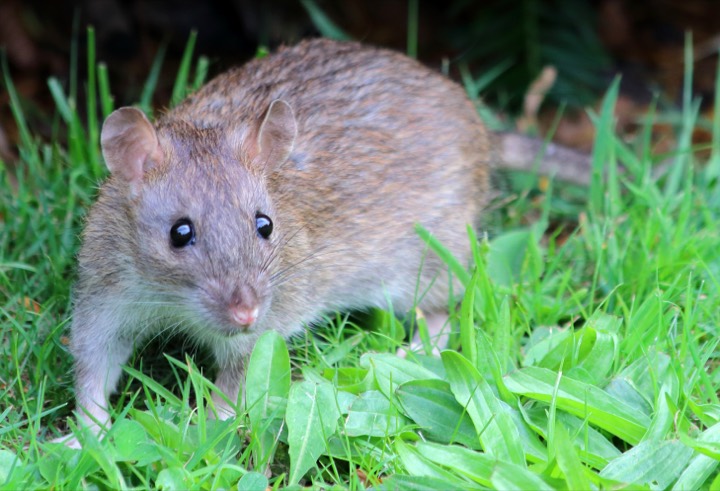

Norway rats are the rat you will see here
When there is a rat in York Region, it is almost always a Norway rat, also called the brown or sewer rat. It burrows rather than climbs, prefers the ground floor and the basement, and nests outdoors through the warm months before pushing inside as the weather turns. That behaviour is why the burrow, not the snap trap, is the centre of the job. A Norway rat will dig a burrow system three feet long with a main entrance and a bolt-hole escape, and it will keep using it as long as there is food and cover nearby.
Kill the rats inside and leave the burrows in the yard, and you have cleared a shift, not a colony. The next set moves in through the same holes within weeks.
Why rats are less of a York Region problem, and where they still show up
York Region is not the dense, older city core where rats thrive. Most of it is newer subdivisions on newer servicing, lower density, and fewer of the old brick-and-block basements and laneways that give rats year-round harbourage. That is why the region sees far more mouse work than rat work. Where rats do turn up, it tends to be in the older pockets, the established parts of Thornhill, Unionville, and downtown Richmond Hill and Newmarket, and around active construction, which turns over soil and pushes any existing colony out into the surrounding streets. Garbage and green-bin organics, backyard compost, dropped fruit, and the cover under decks and sheds feed and shelter them once they arrive.
That is why we start outside. We walk the property line, the foundation, the deck, the shed, and the garbage area, and we find where the rats are living before we decide where anything goes. Bait in the kitchen does nothing about a burrow under the back deck.
Why bait alone fails
Bait has a place, but on its own it is the slowest and least reliable way to clear rats, and around a home it carries real risk. Health Canada requires rodenticides near homes to be used inside tamper-resistant stations, locked boxes a rat can enter but a pet or child cannot, precisely because loose bait poisons the wrong animals. See the PMRA guidance on rodenticide safety.
Three problems with a bait-only approach:
- It does not close the door. New rats keep arriving through the same burrows and gaps, so the station empties forever and the problem never ends.
- It can kill a rat in your wall. A poisoned rat dies wherever it happens to be, and a decomposing rat in a wall cavity smells for a week or more with no way to reach it.
- It moves up the food chain. A poisoned rat that staggers into the open can be eaten by a cat, a dog, an owl, or a hawk, which is part of why the industry is moving toward reduced-rodenticide, integrated methods.
The bait supports the work. It does not replace it.
Exclusion is the part that lasts
Exclusion means sealing the openings a rat uses so the ones you remove cannot be replaced. A rat can squeeze through a gap about the size of a quarter, roughly 20 millimetres, and will gnaw a smaller one wider. So the sealing has to be done in materials a rat cannot chew: galvanized hardware cloth, sheet metal, mortar, and concrete, not foam or steel wool alone, which a determined rat defeats.
The usual entry points we close on a York Region property: gaps where pipes and utilities enter the foundation, deteriorated mortar and foundation cracks, uncapped drain and vent openings, gaps under garage doors, and holes gnawed at door and frame corners. Outside, we collapse and backfill active burrows once the colony is controlled, so the harbourage is gone for good.
The neighbourhood dimension
Rats do not respect a property line. A colony living in a neighbour's woodpile, an unmanaged compost two doors down, or a construction site at the end of the street will keep sending rats onto your lot no matter how clean your own yard is. That is the frustrating part of a rat problem and the reason it is partly a shared, civic problem rather than a private one.
You can control your own property, which you are required to do, and you can report the wider source so your municipality can act on it. We cover what to control and what to report, including who to contact and when, on the York Region rat problem page. On the ground, the practical move is to remove the food and cover on your side while the whole block does the same, because a single sealed yard beside ten open ones is a much harder win.
Your legal duty to keep the property rodent-free
In York Region you are not just allowed to deal with rats, you are required to. Each local municipality, Markham, Vaughan, Richmond Hill, Newmarket, Aurora and the rest, runs a property-standards bylaw that puts the responsibility on the owner to keep the property free of rodents and to clear the conditions that harbour them, and York Region Public Health backs that up on the health side. An owner who ignores a rat problem can face an order and enforcement, not just an infestation.
Under your municipality's property-standards bylaw, keeping the property free of rats is the owner's legal obligation, and York Region Public Health treats rodent harbourage as a health matter. Doing the exclusion and cleanup is how you meet that duty, and it is a defence if a neighbour complains.
What rat control costs in York Region
A standard York Region rat job runs $300 to $600 or more. Rats cost more than mice because the work is heavier: exterior burrow treatment, sealing in metal and mortar rather than foam, and usually more than one follow-up to confirm the colony is down and staying down. The range depends on how many burrows are active, how much exterior exclusion the foundation and yard need, and whether rats have already moved inside.
| Job | Typical York Region range |
|---|---|
| Light activity, limited exterior baiting + minor sealing | $300 to $400 |
| Standard job: burrow treatment + foundation exclusion | $400 to $550 |
| Heavy infestation / extensive exclusion / interior activity | $550 to $600+ |
| Follow-up visits (included in most jobs) | usually no extra charge |
The firm number comes after the free inspection, because the burrow count and the amount of sealing are what move the price and we will not guess at them over the phone. The full cost page breaks down every pest. Waiting is the expensive choice with rats: a couple of burrows in early fall is a contained job, while an established colony that has bred through the winter and moved into the walls is a much larger one.
By town: where rats turn up in Markham, Richmond Hill, Vaughan, Newmarket and Aurora
Rats are the exception in York Region, not the rule, and they turn up where food and cover concentrate.
- Markham: around restaurant plazas and bins along Highway 7, and on lots near the Rouge River valley and its creeks, where burrows run under decks and sheds.
- Richmond Hill: where construction along the Yonge corridor and creek valleys disturbs burrows; most residential rodent calls here still turn out to be mice.
- Vaughan: in Concord's employment lands, where loading docks, pallets, and food on site make rodent control a standing program, and along the Humber valley in Woodbridge, under decks and sheds.
- Newmarket: around the older downtown and commercial properties near Main Street and the Holland River; the subdivisions mostly get mice.
- Aurora: rarely. When we do see them, it is usually around compost, bird feeders, and sheds on the larger treed lots.
Common questions
How do I get rid of rats in York Region for good?
Treat and collapse the exterior burrows, seal every opening a rat can use in metal and mortar, and clear the food and cover out of the yard. Bait on its own will not do it, because it leaves the burrows outside and the entry points open. A lasting job is exclusion plus control, not poison alone.
What is the difference between rat and mouse droppings?
Rat droppings are roughly three times larger, about the size of a raisin, with blunt ends. Mouse droppings are small, the size of a grain of rice, and pointed. Size and shape are the fastest way to tell which animal you have, and here it is much more often a mouse.
Why do I have rats in my yard?
Food, water, and cover. Garbage and green-bin organics, backyard compost, dropped fruit, and the ground cover under decks and sheds all draw and shelter Norway rats. Nearby construction that disturbs the soil, common across York's growing areas, can push an existing colony onto your property.
Are rats dangerous?
Yes. Rats foul food and surfaces, can carry disease, and their gnawing on wiring and pipes creates structural and fire risk. They are a health and safety problem, not only a nuisance.
Do I have to deal with rats, or can I ignore them?
You have to. Your municipality's property-standards bylaw makes keeping the property free of rodents the owner's responsibility, and the town can issue an order if you do not act.
Is bait safe around my pets and kids?
Only when it is used correctly. Health Canada requires rodenticides near homes to sit in tamper-resistant stations that pets and children cannot open, and we use them that way and apply everything to the label. Loose bait in a dish is exactly what those rules exist to prevent.
Does the guarantee cover rats?
Yes. If rats are still active within two months of the treatment, we come back once at no charge.
Reviewed October 2026.
Prefer to talk? Call
(888) 885-3070Tell us the pest and your neighbourhood and we give you a price range on the spot. The inspection is free, and there is no charge to ask.
- Published price ranges, no "call for a quote"
- Free inspection, price locked before we start
- Licensed and insured technicians
- Two-month guarantee, one free re-treatment
- Honest advice if you do not need a pro yet
York Region & the GTA · Same-day, 24/7 for emergencies
Get a straight quote
Tell us what you are seeing and we come back with a price range and a time. No obligation, no on-site surprise.