When a wasp, hornet, or yellow jacket nest turns up by a door, a deck, or the pool in York Region, the fix is fast and most residential nests cost $150 to $400 to remove: we knock the nest down and treat the spot so the colony cannot rebuild there. Most nests come off in a single, same-day visit, and it starts with a free inspection that tells you exactly what you have, a calm paper wasp you could leave alone or a yellowjacket colony that will swarm the moment it is disturbed. The work is carried out by our service partner Insectica Pest Control. If someone in the house is allergic, or the nest is bigger than a softball and near a door, do not touch it. Call and keep your distance.
Wasp, hornet, or bee? How to tell before anyone gets stung
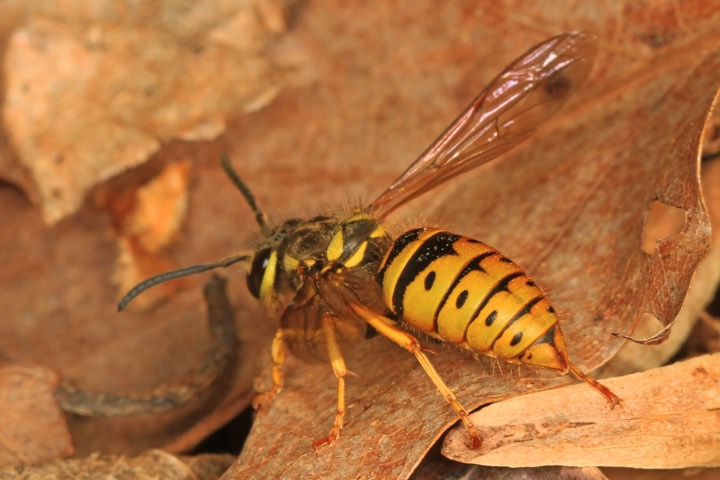
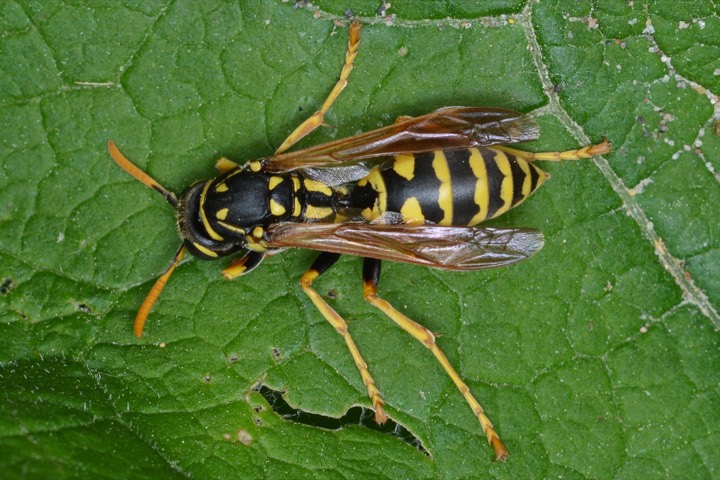
In York Region you are almost always dealing with one of three stinging insects that people lump together, and the difference decides how dangerous the nest is and how it has to be handled. The quickest cut: if the insect is smooth and shiny it is a wasp or hornet, and if it is fuzzy and rounded it is a bee, a pollinator and usually a gentler problem best left alone. Among the smooth ones, here is how to read which is which from a safe distance.
- Yellowjacket. Compact and short-bodied, bright yellow and black, smooth and hairless. They nest in the ground, in old rodent burrows, in retaining walls, and inside wall voids and soffits, so often all you see is a steady stream coming and going from one hole. They turn very aggressive near food, garbage bins, and open drinks, and each one stings again and again. This is the classic late-summer wasp that ruins a backyard barbecue on a Markham or Vaughan patio, and the nest that puts people in the emergency room.
- Paper wasp. Slender and longer, with long legs that dangle noticeably in flight. It builds the open, umbrella-shaped nest that hangs under an eave, a soffit, a deck rail, or a porch roof, and you can see the honeycomb cells from below. Paper wasps are the least aggressive of the three and will mostly leave you alone unless you swat at the nest itself.
- Bald-faced hornet. Larger than a wasp, black and white rather than yellow, and the builder of the big grey enclosed "football" nest you see hanging in a tree or off a wall. The size is the tell: a mature nest can hold hundreds, and hornets are very defensive close to it. On the treed estate lots of Kleinburg, King, and Aurora, and along the ravine and greenspace edges that back so many York backyards, these turn up high in a mature tree more often than people expect.
- Bees, for contrast. A honeybee or bumblebee is fuzzy and rounded, nests as a cluster of insects or in a cavity rather than in grey paper, and is a pollinator that is often best left alone or saved alive. If your insect is fuzzy rather than smooth, and there is no grey paper nest, you are looking at a bee, which is a different and usually gentler situation than anything on this page.
If the nest is a closed grey ball, or the insects are streaming out of a single hole in the ground, a wall, or the soffit, treat it as aggressive and keep everyone well back. Paper wasps under a rail are the one case where waiting is sometimes fine. Everything else is a call.

_-_Mississauga,_Ontario_2016-08-07.jpg)
Where wasp nests hide in York Region homes
Half the job is finding the nest, because the treatment depends entirely on where it is. On York Region's larger suburban and estate properties the nests turn up in the same handful of places.
- Soffits and eaves. The most common by far on the newer two-storey homes across Markham, Vaughan, and Richmond Hill. Yellowjackets and paper wasps slip into a gap in the soffit or a corner of the eave and build inside the cavity, so all you see is insects entering one spot near the roofline. A soffit colony can chew through the interior finish and end up inside a ceiling or an upstairs room, which is how wasps sometimes turn up indoors.
- Ground and retaining-wall nests. Yellowjackets move into old rodent burrows, the space under a shed or deck, and the gaps in a stone or block retaining wall. On a big treed lot you usually find these the wrong way, with a lawn mower or a foot, which is exactly when they swarm.
- Umbrella nests under decks, porches, and sheds. Paper wasps hang their open honeycomb nest under a deck rail, the underside of deck boards, a porch roof, a pergola, or inside a garden shed, anywhere dry and sheltered from the rain. The generous decks, sheds, and playsets that come with York backyards give them a dozen sheltered ledges to choose from.
- Football nests in trees and on walls. Bald-faced hornets build the large grey enclosed nest in a tree, a tall hedge, or against the wall under an eave, often high up and out of easy reach. The mature trees on older estate lots and the greenspace edges backing onto ravines are where these show up.
- Pool areas and attic vents. Behind pool equipment, up under a slide, or in through a roof vent and into the attic, the worst version because the nest is then inside the structure.
The harder a nest is to reach, buried in a soffit or high in a hornet-favoured tree, the more time the job takes, and that access is the single biggest thing that moves the price.
Why removing a wasp nest yourself is genuinely dangerous
A wasp nest is not the kind of chore you knock off with a can from the hardware store, and the reasons stack on top of one another.
First, wasps sting repeatedly. Unlike a honeybee, which dies after one sting, a single wasp or hornet can sting again and again, and a disturbed nest releases an alarm signal that calls the rest of the colony out to join in. Spray a store aerosol at a yellowjacket nest, miss the hole, and you get a cloud of angry insects and dozens of stings in seconds. Second, disturbing the nest is exactly what triggers the swarm, so the moment you knock, poke, or spray it, the whole colony defends at once. Third, most nests are up high or buried in the structure, so you are on a ladder or leaning into a soffit when the swarm comes, and the fall does more damage than the stings. Fourth, the calendar works against you: by August and September the colony is at its largest and most defensive, right when families are still out on the deck and by the pool.
The store-spray problem deserves its own line. A hardware-store aerosol will chase the wasps out of a wall or soffit for an evening and rarely kills the nest inside the void, so you are left with an agitated, partial colony that rebuilds and comes back angrier. The products that actually clear a concealed nest are registered by Health Canada's Pest Management Regulatory Agency and are meant to be applied to the label by a trained technician.
If anyone at the property is allergic to stings, do not go near an active nest, and do not let anyone else knock it down. A swarm can deliver enough venom to trigger anaphylaxis, even in a person who has never reacted before. If someone is stung and shows swelling of the face or throat, trouble breathing, dizziness, or hives spreading across the body, call 911. For a large nest, a ground nest, a nest inside a wall or soffit, a nest near a doorway, or anyone with a sting allergy in the home, skip the do-it-yourself entirely and call.
How we remove a York Region wasp nest
- Locate the nest and the entry. Insectica's technician confirms whether it is a yellowjacket, a paper wasp, or a bald-faced hornet, and finds exactly where the nest sits and where the insects are getting in. That decides the approach and the price before anything is treated.
- Treat to knock down the colony. A Health Canada PMRA-registered product goes straight into an accessible nest, applied to the label. For a soffit, wall, or ground nest, the entry point is treated so returning wasps carry the product into the colony and it dies from the inside.
- Remove the accessible nest. Once the colony is dead, an accessible nest comes down. A nest buried in a void is left to die out rather than torn open.
- Treat and seal the void so they do not rebuild. The cavity and entry are treated and, where it makes sense, sealed, because an open soffit or wall gap is an invitation to next year's queen to build in the same spot.
- Stand behind it. The work carries a two-month guarantee. If wasp activity returns at the same nest within that window, Insectica comes back once at no charge.
Most standard nests are same-day and done in a single visit.
What wasp nest removal costs in York Region, and when to call
We will not print a fake firm number, because the honest price depends on what you have and where it is. A wasp or hornet nest in York Region typically falls in the $150 to $400 range for a residential job, with two things deciding where you land: how high or buried the nest is, and how big the colony has grown. An accessible nest you can point at, hanging under an eave or a deck, sits at the lower end. A yellowjacket colony sealed inside a wall or soffit that has to be reached and treated in the cavity sits higher, and a nest that cannot wait for morning adds an after-hours call. The firm number comes after the free inspection, once a technician has actually seen the nest, and every service and how it is priced is laid out on the pest control cost page.
Timing is the other half of the cost, and it runs in your favour if you move early. A wasp nest is smaller, lower-risk, and cheaper to deal with in June, when the queen and a few workers are just getting started and the whole thing is the size of a golf ball. By August and September that same nest can hold thousands and is at its most defensive, which is both a harder job and a more dangerous one, so the calls spike exactly when the nests are worst and the pool deck is still in use. Wasps die off with the first hard frost, usually late October in York Region, and they do not reuse an old nest the next year, so a high, empty-looking nest in November can often simply be left. Through the summer, though, an active nest near a door, a walkway, or a pool is not a wait-and-see problem.
For a business, a rental building, or a condo board with a nest on the structure, the documented, scheduled version of this work is covered under commercial pest control.
Signs it is time to call
- Wasps streaming in and out of one hole in the ground, a wall, or the soffit.
- A grey football-shaped or closed ball-shaped nest anywhere near the house or in a nearby tree.
- A nest within reach of a door, a walkway, a patio, a pool deck, or a kid's play area.
- More than a handful of wasps indoors, which can mean a nest inside a wall, a soffit, or the attic.
- Anyone in the home with a known sting allergy and any active nest on the property.
We would rather come out same-day for a nest that turns out to be small than get the call after someone has been stung a dozen times trying to knock it down themselves.
By town: wasp and hornet nests in Markham, Richmond Hill, Vaughan, Newmarket and Aurora
Nests go where there is shelter near food and water, so the big yards, decks, and pools of York Region give them plenty of options.
- Markham: soffits, sheds, and decks on the large heritage and estate lots in Unionville and Markham Village, and ground nests in subdivision lawns.
- Richmond Hill: soffits and sheds on the detached homes in Jefferson, Richvale and Oak Ridges, and nests near docks and decks by Lake Wilcox.
- Vaughan: pool decks, sheds, and eaves on the estate lots of Woodbridge and Kleinburg and the larger homes in Maple and Vellore.
- Newmarket: ground-nesting yellow jackets in lawns near Fairy Lake and along trail edges, and soffit nests on the older lots near Main Street.
- Aurora: the big treed yards, sheds, eaves, and deck soffits across town, and ground nests next to patios.
Common questions
Is it a wasp or a bee?
Wasps and hornets are smooth and shiny with a pinched waist; bees are fuzzy and rounded. Wasps build papery grey nests, an open umbrella under an eave or a closed ball in a tree or wall, while bees nest as a cluster of insects or in a cavity. If it is smooth-bodied and the nest is grey paper, it is a wasp or hornet and this is the right page. If it is fuzzy, it is a bee, which is usually a gentler and different situation and not something you want treated the same way.
How much does wasp nest removal cost in York Region?
A wasp or hornet nest typically runs $150 to $400 for a residential job. An accessible nest under an eave or deck is at the lower end; a colony sealed inside a soffit or wall that has to be reached costs more, and an after-hours call adds to it. The firm price comes after a free inspection, because a yellowjacket nest inside a two-storey soffit is a different job from a paper wasp nest on a deck rail. Every service is priced on the cost page.
Can I remove a wasp nest myself?
For a small paper wasp nest out in the open, with no one allergic in the home, sometimes. For a ground nest, a nest hidden in a wall or soffit, a hornet nest, or any nest with an allergic person in the household, no. Wasps sting repeatedly, disturbing the nest triggers a swarm, most nests are up a ladder, and a store spray usually leaves an angry partial colony behind.
Do wasps come back after treatment?
Not the same colony. A treated nest is finished, and wasps do not reuse an old nest. What brings them back to the same spot is an open soffit or wall cavity that next year's queen finds just as sheltered, which is why treating and sealing the void matters. The two-month guarantee covers the treated nest.
What if the nest is inside a soffit or wall?
A soffit or wall-void nest is treated at the entry point so the returning wasps carry the product into the colony, rather than torn open, and it is left to die out before the gap is sealed. It takes more time than a nest hanging in the open, and it matters not to seal a live nest too early, because trapped wasps can chew through into a ceiling or an upstairs room. On the newer two-storey homes across York Region this is the most common version, and it is the case least suited to do-it-yourself.
When are wasps most aggressive?
In late summer, August and September, when the colony has grown to its largest and is defending the most workers and brood. That is when nests are biggest, stings are most likely, and yellowjackets swarm around food and bins. A nest is smaller and safer to deal with earlier in the season, which is the argument for calling in June rather than waiting.
Do you remove hornet nests?
Yes. Bald-faced hornet nests, the large grey enclosed footballs in trees and on walls, are removed the same way, by treating the colony first and taking the nest down once it is dead. Hornets are very defensive near the nest and it is often high up in a mature tree on an estate or ravine-edge lot, so this is firmly a job to leave to a technician rather than attempt from a ladder.
How much does yellow jacket removal cost?
Most residential yellow jacket nests in York Region cost $150 to $400 to remove. A nest hanging where we can reach it sits at the lower end; a colony inside a wall, soffit, or the ground under a patio, or a call after hours, sits higher. The firm price comes after a free look at the nest.
Can you come the same day for a wasp nest anywhere in York Region?
In most cases, yes. We take same-day wasp, hornet, and yellow jacket calls across Markham, Richmond Hill, Vaughan, Newmarket, Aurora, and the rest of York Region, and treat a nest at a door or near someone with an allergy as urgent.
Reviewed October 2026.
For a nest that cannot wait, or anything with an allergy in the home, see emergency pest control. For a nest on a business or condo property, that is commercial pest control. How every service is priced is on the cost page.
Prefer to talk? Call
(888) 885-3070Tell us the pest and your neighbourhood and we give you a price range on the spot. The inspection is free, and there is no charge to ask.
- Published price ranges, no "call for a quote"
- Free inspection, price locked before we start
- Licensed and insured technicians
- Two-month guarantee, one free re-treatment
- Honest advice if you do not need a pro yet
York Region & the GTA · Same-day, 24/7 for emergencies
Get a straight quote
Tell us what you are seeing and we come back with a price range and a time. No obligation, no on-site surprise.