We remove bees and carpenter bees across York Region, and the first thing we do is tell you exactly what you have. A fuzzy honeybee colony in a wall, a bumblebee nest under the deck, a carpenter bee drilling perfect round holes into the fascia of a Markham home, and a yellowjacket that everyone in the backyard calls a bee are four different problems with four different answers. Get the identification wrong and you either pay to remove something that could have been left alone or you poke a nest that stings back. So we start with a free inspection, name the species, and only then decide whether it comes out, gets sealed, or is better handled by a beekeeper. Most jobs are same-day. The work is carried out by our service partner Insectica Pest Control.
First, is it actually a bee?
Before anyone treats anything, the insect has to be identified, because a large share of the "bee" calls we get across York Region are not bees at all. Here is how to tell the four common ones apart from a safe distance.
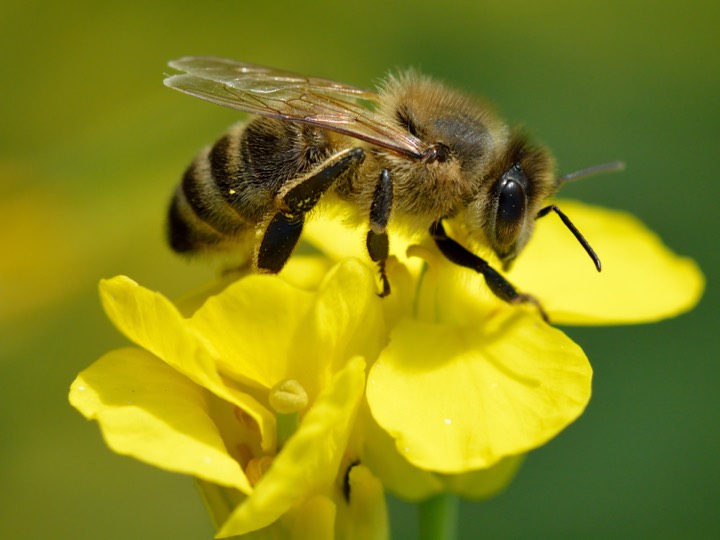
- Honeybee. Golden-brown and banded, fuzzy, and small at around 12 mm. Honeybees are social, live in colonies of thousands, and are docile away from the hive because they die when they sting and only do it to defend. They are the pollinator you have heard is in trouble, and that matters for how their case is handled. A honeybee colony in a wall shows as a steady, calm stream of bees in and out of one gap, often with the faint smell of wax and honey on a warm day.
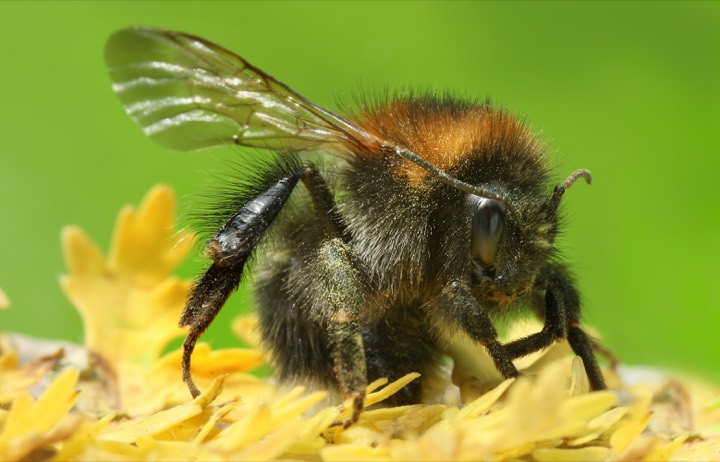
- Bumblebee. Large, round, and very fuzzy, with bold black-and-yellow bands. Bumblebees nest in small numbers, usually in the ground, an old rodent burrow, under a shed, or in a wall cavity with soft insulation, and on the larger lots around King, Georgina, and Whitchurch-Stouffville they turn up in the rough grass at the edge of a property as often as against the house. They are docile and will not bother you unless you disturb the nest directly, and they are also important pollinators. Most bumblebee nests away from a doorway can simply be given a wide berth until they die off naturally in fall.
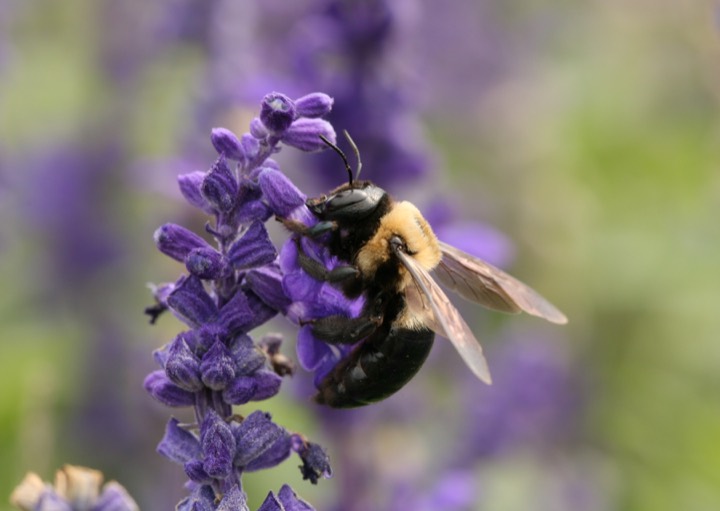
- Carpenter bee. Also large, but the tell is the abdomen: shiny, black, and hairless, where a bumblebee's is fuzzy all over. If you see a big bee boring a clean, almost perfectly round hole about a centimetre wide into wood, that is a carpenter bee, and no other bee in the region does that. The males hover and dive-bomb your head at the nest and look terrifying, but males have no stinger and cannot sting you at all. The females can sting but almost never do.
- The imposters: wasps, hornets, and yellowjackets. These get called "bees" constantly and they are not. They are smooth and shiny rather than fuzzy, they have a pinched narrow waist, and they build papery grey nests, an open umbrella under a soffit or a closed ball in a tree or wall. They are far more aggressive, they sting repeatedly, and August is their bad month. The big suburban yards of Vaughan and Richmond Hill generate a steady run of "there are bees in the yard" calls in late summer that turn out to be yellowjackets nesting in the ground or a retaining wall. If the insect is smooth-bodied and the nest is grey paper, you are almost certainly looking at wasps, which is a different job with a different plan, covered on the wasp nest removal page.
The short version: fuzzy and banded is a bee, smooth and papery-nested is a wasp. A shiny black-bottomed bee drilling round holes in your deck is a carpenter bee. Get that right and the rest of the decision is easy.


The honeybee question, handled honestly
We should be straight with you about honeybees, because it changes what the right call is.
Honeybees are protected, valuable pollinators, and a true honeybee swarm, that big docile cluster that lands on a branch or a fence post for a day or two, can very often be collected alive and free by a local beekeeper who wants the bees. An established honeybee colony inside a structure can sometimes be cut out and relocated alive too, though that is a bigger job. Where saving the bees is practical, it is genuinely worth doing and it is better for the environment, and we will tell you so rather than reach for a spray.
That said, live relocation is not always practical or safe. When a colony is established deep inside a wall or roof and cannot be reached without opening up the structure, when a colony has turned aggressive, or when someone in the household has a serious sting allergy, waiting on a beekeeper is not the answer. In those cases, and for the other bee types, our partner Insectica removes them by extermination. We do not relocate bees ourselves and we will not pretend we do. What we will do is give you an honest read on whether a beekeeper is the better first call for a honeybee swarm, and step in when removal is the sensible option.
If you have a calm cluster of honeybees that arrived in the last day or two and has not gone into a wall yet, call a local beekeeper or a beekeeping association before anyone treats it. A fresh swarm is the easiest kind to save alive, and many beekeepers collect them at no charge.
Carpenter bees: the damage most people miss
Carpenter bees are the pest on this page worth understanding in detail, because the damage is quiet, it compounds, and spring is the window to stop it.
A female carpenter bee does not eat wood. She bores a clean round tunnel into it to make a nursery, then turns and excavates a gallery along the grain to lay her eggs. She goes for the same wood every time: unpainted or weathered fascia and soffits, deck boards, railings, eaves, pergolas, and cedar or other softwood trim. That is exactly what York Region has a lot of. The large detached homes of Markham, Vaughan, and Richmond Hill come with generous wood decks, pergolas, and painted fascia, and the treed estate lots of Kleinburg, King, and Aurora add cedar railings, exposed softwood beams, and outbuildings sitting among the trees. All that exposed softwood is prime carpenter-bee territory.
Here is why a couple of holes is not a nothing problem. Carpenter bees reuse and extend the same galleries year after year, so what starts as one finger-length gallery becomes a network running through the board. And they attract a second attacker. Woodpeckers hear or smell the larvae inside and tear the wood open to eat them, turning a pencil-width entry hole into a ragged gash and multiplying the damage well beyond what the bees alone would do. On the treed lots north and west of the region, where woodpeckers are common, that second stage is a real risk. Left for several seasons, that is how a fascia board, a pergola beam, or a deck railing goes from sound to soft to needing replacement.
The signs are easy to spot once you know them: perfectly round holes about a centimetre across, often on the underside of a board where it is sheltered; fresh coarse sawdust on the ground or deck below the hole; yellowish staining streaking down from the entrance; and in spring, large bees hovering and patrolling around the eaves and railings.
How the treatment works. Insectica's technicians treat the galleries with a registered product, usually a dust, worked into the tunnels. The point of treating the gallery rather than just plugging the hole is that returning and emerging bees pass through the treated tunnel and carry it in, which clears the ones you cannot see. After the galleries are treated, the durable fix is to seal the holes and then paint or finish the exposed wood, because carpenter bees strongly prefer bare, weathered softwood. Sealing an untreated active gallery too early just traps live bees who chew a fresh exit, so the order matters: treat first, seal after.
Timing is the whole game with carpenter bees. They emerge and start boring in spring, so a spring treatment stops the boring before a season's worth of galleries and woodpecker damage happens. Treating in spring prevents a summer of damage, which is why this is the one bee call worth making early rather than waiting to see how bad it gets.
Why bee removal is not a DIY job
Bees look manageable right up until they are not. A few things go wrong, often together.
First, stings and allergies. Any bee sting hurts, but for someone with a sting allergy a defensive nest is a medical emergency. Anaphylaxis can set in fast, and a person can react severely even if they never have before, so if anyone at the property has a known sting allergy, no one in the household should be near an active nest.
Second, defensive swarming. A honeybee or bumblebee colony that is calm day to day will pour out to defend the nest the moment it is disturbed, and swatting, spraying, or knocking at a nest is exactly the trigger. That is how a small job becomes dozens of stings in seconds. It gets worse when the nest is awkward, inside a wall void, in a soffit, or high on the eaves of a two-storey home, because being on a ladder when a colony boils out is how the sting problem becomes a fall problem.
Third, the wrong product makes it worse. A can of hardware-store spray emptied into a wall colony rarely reaches the whole nest. It agitates the bees, leaves brood and honeycomb behind, and with honeybees a botched job can leave abandoned comb and honey in the wall that then attracts other pests and seeps through the drywall. The job is finding the whole nest and treating it properly, not chasing the bees you can see.
How we remove bees
The process is deliberate, and it starts with getting the species right.
- Identify and locate. A technician confirms the species, honeybee, bumblebee, or carpenter bee, and finds the actual nest or gallery, not just the entrance the bees are using. This decides the whole plan and, for honeybees, whether relocation should be considered first.
- Treat or remove. Using Health Canada PMRA-registered products applied to the label, the nest or gallery is treated, and the accessible nest is removed where needed. For carpenter bees the galleries are dusted so returning bees carry the product in.
- Seal so it does not recur. Entry points, gaps, and carpenter bee holes are sealed once the colony is cleared, and exposed wood is flagged for finishing, because an open cavity or bare softwood is an invitation to next year's bees.
- Stand behind it. The work carries a two-month guarantee. If the treated bees are active again in that window, Insectica comes back once at no charge.
Same-day service is available where the schedule allows, and most single-nest jobs are done in one visit.
What bee removal costs in York Region, and when to call
We will not print a fake firm number, because an honest range depends on what you have and where it is. A straightforward, accessible bee nest or a carpenter bee treatment on reachable wood sits at the lower end. The price climbs when a colony is established inside a wall or roof and has to be reached, when there is a lot of carpenter bee gallery to treat across a whole deck or roofline, or when the job needs height access on a large detached home. The firm number comes after the free inspection, once a technician has seen the nest. Every service and how it is priced is laid out on the pest control cost page.
On timing: bees are active from spring through fall and die back with the cold. Bumblebee and honeybee activity peaks through summer. Carpenter bees are the exception that rewards moving early, because they emerge and bore in spring, so a spring treatment heads off a whole summer of tunnelling and woodpecker damage. If you saw carpenter bee holes in the deck or fascia last year, this spring is the time to treat, before the new generation reopens them.
For a business, a rental building, or a condo corporation with bees on the structure, our commercial pest control service covers the documented, scheduled version of this work.
By town: bees and carpenter bees in Markham, Richmond Hill, Vaughan, Newmarket and Aurora
Carpenter bees go for bare, weathered softwood, and honey bees and bumblebees for quiet cavities, so the calls follow the age of the wood and the size of the yard.
- Markham: carpenter bees in the fascia and decks of older homes in Unionville and Markham Village, and bumblebee nests under decks in the subdivisions.
- Richmond Hill: carpenter bees in the decks and fences of the treed lots around Mill Pond and Bayview Hill, and bumblebees in the larger Oak Ridges yards.
- Vaughan: carpenter bees in cedar decks, pergolas, and fences on the Woodbridge and Kleinburg estate lots.
- Newmarket: carpenter bees in porch and trim wood on the older homes near Main Street, and ground bumblebee nests along the trail-side yards.
- Aurora: carpenter bees in the old trim and decks of the heritage core, and honey bee swarms that settle in the big trees, which go to a beekeeper rather than being destroyed.
Common questions
Is it a bee or a wasp?
Bees are fuzzy and rounded; wasps and hornets are smooth, shiny, and have a pinched waist. Bees nest in cavities or wood or as a hanging cluster of insects; wasps and hornets build papery grey nests, an open umbrella or a closed ball. If it is smooth-bodied and the nest is grey paper, it is a wasp, which is a different job covered on our wasp nest removal page.
Do you relocate honeybees or kill them?
We remove bees by extermination and we do not relocate them ourselves. But we will be honest with you: a true honeybee swarm or an accessible colony can often be collected alive by a local beekeeper, which is better for the environment and worth trying first. Where live relocation is not practical, a colony sealed deep in a wall, an aggressive colony, or a real hazard to an allergic household, and for bumblebees and carpenter bees, removal is the answer.
Are carpenter bees dangerous, and do they really damage a house?
They are barely a sting risk. The hovering males cannot sting at all, and the females almost never do. The real harm is to the wood. They bore round tunnels into fascia, decks, railings, pergolas, and cedar trim, reuse and extend those galleries every year, and attract woodpeckers that tear the wood open to eat the larvae. Over several seasons that adds up to structural damage worth preventing.
Will bees come back after treatment?
A treated nest or gallery is finished. What brings bees back to the same spot is an open cavity or bare, weathered wood that the next generation finds just as attractive, which is why we seal entry points and carpenter bee holes and advise finishing exposed wood. The two-month guarantee covers the treated colony.
How much does bee removal cost in York Region?
It depends on the species, where the nest is, and how much access it needs. An accessible nest or a reachable carpenter bee treatment is at the lower end; a colony inside a wall or roof, or extensive carpenter bee galleries across a roofline, costs more because reaching and treating them is more work. The firm price comes after the free inspection, which breaks down every service before any work starts.
Is it safe to remove a bee nest myself?
For most people, no. A disturbed colony swarms to defend itself, most nests are in a wall or up high where you are on a ladder, and a sting is a medical emergency for anyone with an allergy. Hardware-store sprays rarely reach a whole nest and often leave brood and honeycomb behind. If anyone in the home is allergic, or the nest is inside the structure or at height, do not attempt it.
When should carpenter bees be treated?
In spring, when the adults emerge and start boring. Treating early stops the tunnelling before a season's worth of gallery and woodpecker damage happens. If you found round holes and sawdust last year, treat this spring before the bees reopen and extend the old galleries.
Reviewed October 2026.
For smooth-bodied insects and papery grey nests, see wasp nest removal. For large black ants and sawdust indoors, that is carpenter ant control, a different pest often confused with carpenter bees. How every service is priced is on the cost page.
Prefer to talk? Call
(888) 885-3070Tell us the pest and your neighbourhood and we give you a price range on the spot. The inspection is free, and there is no charge to ask.
- Published price ranges, no "call for a quote"
- Free inspection, price locked before we start
- Licensed and insured technicians
- Two-month guarantee, one free re-treatment
- Honest advice if you do not need a pro yet
York Region & the GTA · Same-day, 24/7 for emergencies
Get a straight quote
Tell us what you are seeing and we come back with a price range and a time. No obligation, no on-site surprise.