Silverfish are the small, silver-grey, teardrop-shaped insects that shoot out from behind books and baseboards when a light comes on, and in York Region they almost always trace back to one thing: a humid finished basement. They do not bite, sting, or carry disease, but they feed on the starch and cellulose in paper, cardboard, book bindings, wallpaper paste, and natural fabrics, so a real infestation quietly chews through the boxes and documents you have stored downstairs. The fix is not a spray you repeat forever. Silverfish live where it is damp, and until the lower level dries out they keep coming back. We treat the harbourage and tell you which humidity or leak problem is feeding them. The same damp basement draws house spiders, so silverfish often arrive with a spider control problem, and typical prices for both are on our pest control cost York Region guide. Free inspection, same-day service, two-month guarantee.
How to tell if you have silverfish
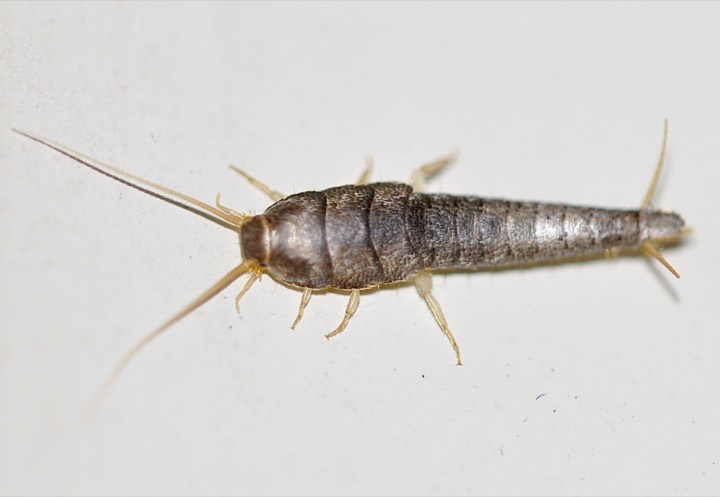
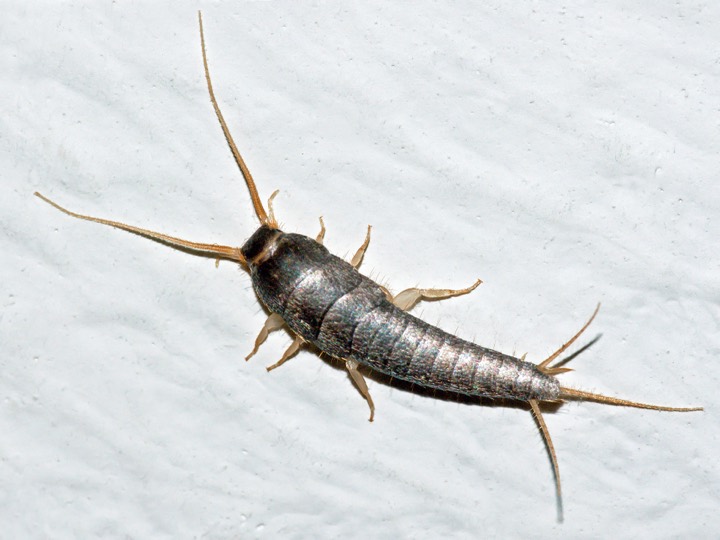
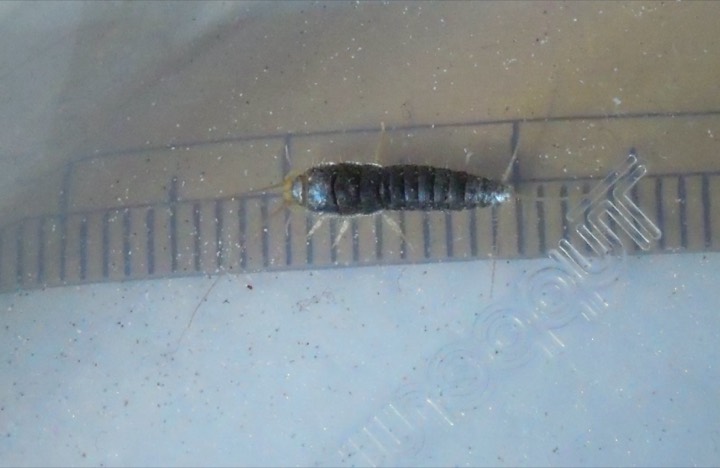
The clearest sign is the insect itself: 12 to 19 millimetres long, silver or grey, carrot-shaped and tapering to the tail, with three bristles at the back and two long antennae, moving in a fast wriggling dash. You usually spot them at night in a basement bathroom or a storage room when the light goes on. When you are not seeing the bug, look for the traces they leave behind:
- Pepper-like droppings, dark specks that look like coarse ground pepper, on shelves, in drawers, and inside stored boxes.
- Yellowish stains and small holes on paper, book pages, wallpaper, and stored clothing, with the surface layer usually scraped away rather than eaten straight through.
- Shed skins, thin translucent moults near feeding sites, because silverfish keep moulting their whole lives.
- Grazed edges on cardboard boxes and book spines where they feed on the starch in the glue and paste.
Silverfish are a symptom of a moisture problem. The insect is what you notice; the damp is what is actually wrong. If you are finding droppings and yellow stains in a finished-basement closet or a storage room, whatever is in there has been feeding them for a while.


Where silverfish hide in York Region homes
Silverfish want the dampest, darkest, most paper-rich corners of a house, and the way York Region homes are built hands them exactly that. The pattern splits two ways:
- Finished basements in the newer detached homes of Markham, Vaughan, and Richmond Hill. The large 1990s-to-2010s subdivision builds almost all have a finished lower level, and a finished basement that is not ventilated the way the main floors are traps humidity against drywall, carpet, and stored boxes. That is prime silverfish habitat.
- Utility and storage rooms around the furnace, the water heater, the laundry, and the sump, where warm damp air collects and cardboard sits on a concrete floor.
- Bathrooms, especially the basement or lower-level bathroom, behind the toilet, under the vanity, and in the gap behind wall tile wherever a fan is missing or unused.
- Older homes in the historic cores of Aurora, Newmarket, Unionville, Markham Village, and Thornhill, where older foundations, plaster, and decades of stored paper hold damp the way newer construction does not.
- Book and paper storage anywhere in the house: bookshelves, filing boxes, and archived documents are a food source and a hiding place at once, and the larger York homes tend to store a lot of it.
The common thread is not the age of the home, it is trapped humidity plus stored paper. A new Vaughan build with a finished basement can have the same problem as a century home in downtown Newmarket.
The honest fix: dry the lower level out first
The one thing that ends a silverfish infestation is taking away the moisture they depend on. Silverfish need high humidity to survive and breed, so drop the relative humidity and they cannot hold on no matter what gets sprayed. Before or alongside any treatment, this is what does the real work:
- Run a dehumidifier in the finished basement, the utility room, and any damp storage area, holding relative humidity below about 50 percent. In a York Region basement this one step breaks most infestations over a few weeks.
- Fix the leaks. A dripping trap under a vanity, a slow toilet, a weeping foundation corner, or a laundry connection. Silverfish cluster wherever the water is.
- Ventilate. Use the bathroom exhaust fan during and after showers, and make sure a finished basement gets real airflow rather than sitting sealed and stagnant.
- Cut the food and shelter. Move stored paper, books, and cardboard off the basement floor into sealed plastic bins, keep pantry goods in sealed containers, and vacuum shelf edges and cracks to lift eggs and droppings.
If a renter's silverfish problem traces back to a leak or a bathroom with no working fan, those are repairs the landlord owes. Ontario's Residential Tenancies Act makes the landlord responsible for maintaining the unit and its plumbing, and a tenant can take an unresolved repair to the Landlord and Tenant Board. On top of that, every York municipality (Markham, Vaughan, Richmond Hill, Newmarket, Aurora and the rest) runs a property-standards bylaw requiring homes to be kept in good repair and free of pests. We will tell you plainly when the fix is a repair, not a spray.
How Insectica treats silverfish
We pair targeted product with the moisture guidance above, because product without the moisture fix is only a temporary result. On a silverfish job we:
- Inspect for free to map where they are feeding and, more to the point, where the damp is coming from.
- Apply crack-and-crevice treatment with Health Canada PMRA-registered product placed directly into the harbourage: baseboard gaps, cracks around tile and plumbing, the backs of shelves and cabinets, and wall voids.
- Hand you the moisture plan specific to your home: which room to dehumidify, which leak to fix, which storage to move, so the result actually holds.
Every product we use is PMRA-registered and applied to the label. The work is carried out by Insectica Pest Control, owner-operated and not a franchise, and there is no upsell: if the honest fix is a dehumidifier in the basement and a repaired trap under the vanity, that is what we will tell you.
Silverfish are the pest where the cheapest fix is often the customer's own dehumidifier. We would rather say that and earn the call than sell a spray that wears off.
The other pests that follow the same damp
Silverfish share their humid, hidden habitat with the other moisture-loving pests, so finding one often means the conditions are right for others. If you are also seeing something faster and larger in the basement or kitchen at night, read the cockroach control page, because roaches want the same warm, damp cracks. Ants also push indoors following moisture; the ant control page covers those. For what any of this runs, the pest control cost page breaks it down by pest and home size.
By town: silverfish in Markham, Richmond Hill, Vaughan, Newmarket and Aurora
Silverfish follow damp, so the question in every town is how the lower level was built and how dry it stays.
- Markham: older homes in Unionville and Markham Village with original basements, and finished basements with below-grade bathrooms across the subdivisions.
- Richmond Hill: homes near Lake Wilcox and the Moraine with higher groundwater, and finished basements in Jefferson and Richvale.
- Vaughan: large finished basements in Woodbridge, Maple and Vellore, where a basement bathroom or laundry keeps humidity up.
- Newmarket: the older homes near Main Street and Fairy Lake, with older foundations that wick moisture.
- Aurora: heritage homes in the Yonge and Wellington core, and finished basements in Regency Acres and Aurora Highlands.
Common questions
Are silverfish dangerous or harmful to people?
No. Silverfish do not bite, sting, carry disease, or damage the structure of the house. They are harmless to you and your pets. The harm is to your belongings: they feed on and stain paper, books, cardboard, wallpaper, and natural fabrics, so a large infestation slowly damages stored documents, photos, and clothing.
What causes silverfish in a York Region home?
Humidity plus a starchy food source. Silverfish need damp conditions to survive, so they turn up in humid finished basements, utility and storage rooms, and poorly ventilated bathrooms. Paper, cardboard, book bindings, wallpaper paste, and dry pantry goods feed them. The finished lower levels common in Markham, Vaughan, and Richmond Hill homes are prime conditions when the humidity is not controlled.
Will silverfish go away on their own?
Not while the space stays damp. They keep living and breeding as long as the humidity and food are there, and they are slow, long-lived insects, so an untreated infestation persists for months or years. Take away the moisture and the population cannot sustain itself. Drying the lower level out is what makes them leave.
Do I need a professional, or can I treat silverfish myself?
A small, early problem you can often handle: run a dehumidifier, fix the leak, seal your dry goods and paper storage, and set out silverfish traps. Call a professional when you are seeing them in more than one room, finding droppings and damage in stored items, or they keep coming back after you have dried things out, which usually means they are harbouring in wall voids or around plumbing you cannot reach.
How long does silverfish treatment take to work?
The crack-and-crevice treatment starts cutting activity within days, but fully ending the infestation depends on the moisture. Once basement humidity is down and the harbourage is treated, most York Region homes are clear within a few weeks. Our two-month guarantee covers it: if silverfish are still active within two months, we come back once at no charge.
What damage do silverfish actually do?
They feed on starch and cellulose, so they eat and stain paper, books, photographs, wallpaper and its paste, cardboard, and natural fabrics like cotton, linen, and silk. They scrape the surface and leave yellow stains, small irregular holes, and pepper-like droppings. They do not harm the building itself, but stored documents, archives, and clothing in a finished basement are at real risk during a long infestation.
Reviewed October 2026.
Prefer to talk? Call
(888) 885-3070Tell us the pest and your neighbourhood and we give you a price range on the spot. The inspection is free, and there is no charge to ask.
- Published price ranges, no "call for a quote"
- Free inspection, price locked before we start
- Licensed and insured technicians
- Two-month guarantee, one free re-treatment
- Honest advice if you do not need a pro yet
York Region & the GTA · Same-day, 24/7 for emergencies
Get a straight quote
Tell us what you are seeing and we come back with a price range and a time. No obligation, no on-site surprise.